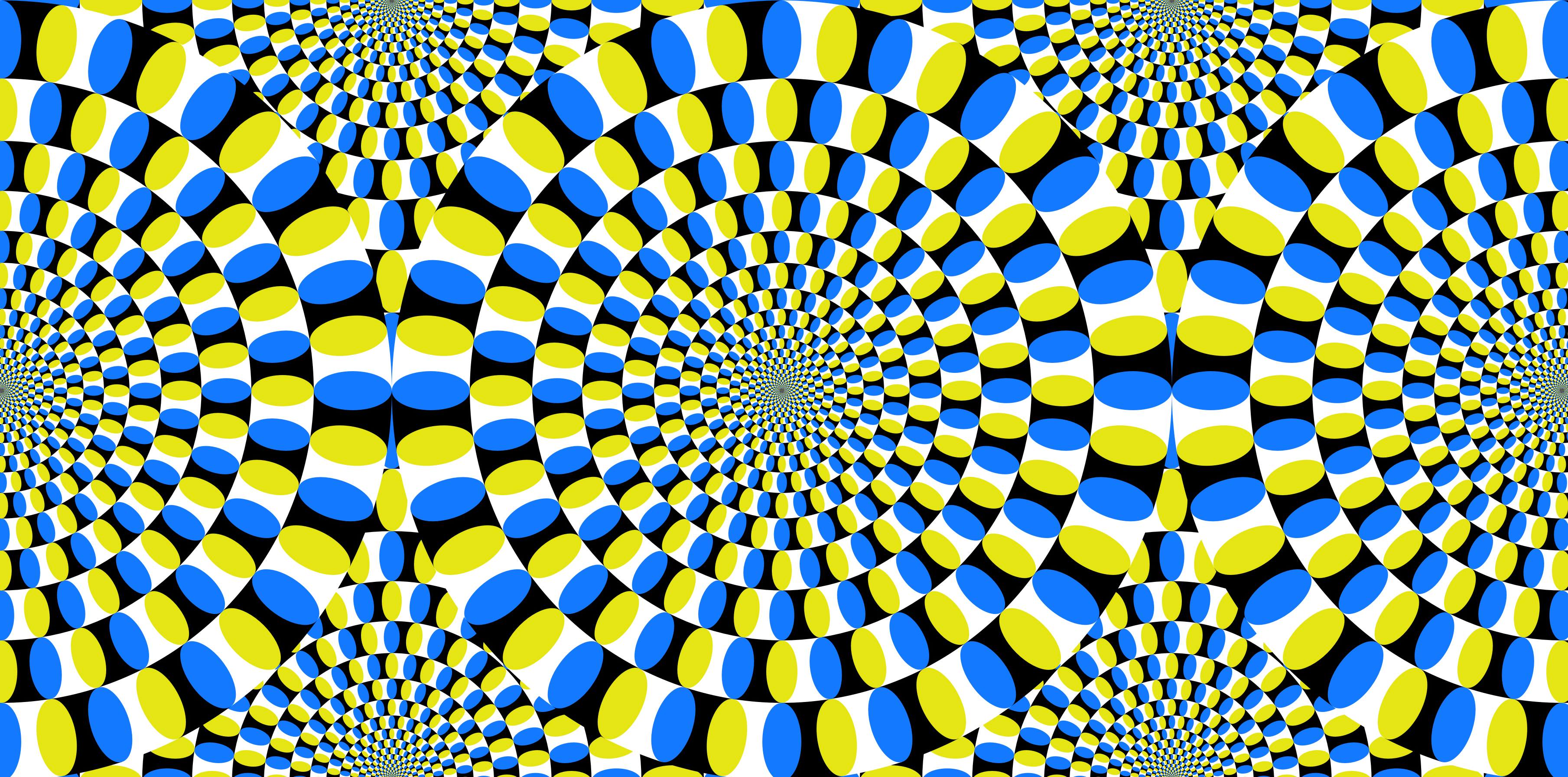
The Rotating Snakes illusion was devised by Akiyoshi Kitaoka, and is shown on the upper right. The pattern contains carefully positioned tiles that vary in luminance and colour. Despite being stationary, the pattern appears to move briefly whenever the viewer blinks or moves their eyes. The illusion is closely related to the Peripheral Drift illusion which was first described in the 1970’s. Although the illusion has been studied extensively, its origin is still debated.
Patrick Cavanagh and I recently tested the idea that the illusion is caused by reflexive changes in pupil diameter that occur whenever you blink or make a saccadic eye movement. The resultant changes in retinal luminance could generate responses in neural motion detectors. We tested the idea by measuring pupil size concurrently with illusion duration, and results published in 2025 are consistent with it.
Another way to test the idea is to vary the luminance of a simple illusion pattern to mimic the changes in luminance caused by the pupil reflex. The demo at bottom right shows the result: The pattern does appear to move while its luminance is modulated.
See:
Faubert, J., & Herbert, A. M. (1999). The peripheral drift illusion: A motion illusion in the visual periphery. Perception, 28, 617–621.
Kitaoka, A., & Ashida, H. (2004). Phenomenal characteristics of the peripheral drift illusion. Vision, 15, 261–262.
Mather, G., & Cavanagh, P. (2025). Pupil dilation underlies the peripheral drift illusion. Journal of Vision, 25, 13.